household · 7 min read
Is a Space Heater Cheaper Than Turning Up the Heat?
On high, most space heaters draw 1,500 watts. Do the per-hour math on your own rate, then see when one room beats the whole house.
By WarmLark Editors · Updated October 2026

A space heater is cheaper only when it lets you turn the central heat down and keep just the room you’re in warm. On its high setting a typical plug-in heater draws 1,500 watts, so every hour costs 1.5 times what you pay per kilowatt-hour. Leave the thermostat where it was and the heater is a second bill stacked on the first.
Whether the trade pays off for you depends on how long you run it and what kind of heat it lets you switch off, and both answers are sitting on bills you already have.
What one hour costs
Your electric bill lists a price per kilowatt-hour, sometimes split into a supply charge and a delivery charge. Add the two together and multiply by 1.5 for the high setting. Most heaters run at 750 watts on low, so for low you multiply by 0.75.
At 17 cents per kilowatt-hour, an hour on high costs about 26 cents and an hour on low about 13. At 12 cents it’s 9 cents on low and 18 on high, and at 25 cents it’s 19 and 38.
Rates differ a lot from one utility to the next, so the chart runs three example rates and leaves out any national average.
From one hour to one month
Running time is what makes this show up on the bill. Run the heater on high through an 8-hour workday in a home office and it uses 12 kilowatt-hours, about $2.04 at 17 cents. Keep that up for 30 days and it adds $61.20.
On low, the same day uses 6 kilowatt-hours and costs $1.02, and the month comes to 180 kilowatt-hours and $30.60.
| Running time | Low, 750 W | High, 1,500 W |
|---|---|---|
| 1 hour | 0.75 kWh, $0.13 | 1.5 kWh, $0.26 |
| 8 hours | 6 kWh, $1.02 | 12 kWh, $2.04 |
| 30 days of 8 hours | 180 kWh, $30.60 | 360 kWh, $61.20 |
Example: one heater at 17 cents per kilowatt-hour, running without a break.
Treat those figures as a ceiling, since they assume the heater never switches off, and most don’t run that way.
If your utility has a smart meter, its website or app usually shows your use by the hour. A heater’s 1.5 kilowatts stands out clearly, and a week of that data tells you what yours really costs to run in your room, with your drafts and your habits.
What moves your real number
Most plug-in heaters have a built-in thermostat. Once the room reaches the setting, the heating element cuts out and the meter slows, then the element comes back on as the room cools. A small room with the door shut lets the heater rest a lot of the time. A big room with a drafty window can keep it at full power all afternoon.
The Energy Information Administration counts 3,412 Btu of heat in one kilowatt-hour, so a 1,500-watt heater puts out about 5,118 Btu an hour. That’s plenty for a bedroom or a small office and not much against an open living area that leaks heat.
Low or high makes little difference
The setting matters less than most people think. Holding a room at 68 degrees takes the same heat whether low or high supplies it, and high just gets there faster before it cycles off. Low only saves you money if it leaves you a little cooler.
If the room feels comfortable on low, leave it there. If it doesn’t, use high and let the built-in thermostat do the cycling.
One warm room in a cooler house
The savings never come from the heater. They come from the furnace or heat pump running less while the heater keeps one room comfortable. The Department of Energy’s Energy Saver page on thermostats says you can save as much as 10 percent a year on heating and cooling by turning the thermostat back 7 to 10 degrees for 8 hours a day.
Zone heating is that same setback with one exception. The thermostat drops to 60 degrees while you work, and the heater holds the room you’re in at 68 with the door closed.
The heat it replaces
The answer turns on what heats the rest of your home.
Electric baseboards and electric furnaces make heat the same way a space heater does, so a unit of heat costs the same from either one. Every degree you drop in the rest of the house is money you keep, and zone heating wins almost every time.
A heat pump is harder to beat. The Energy Saver page on electric resistance heating says heat pumps easily cut electricity use by 50 percent compared with resistance heating, the kind a plug-in heater uses. Unit for unit, then, heat from your space heater costs about twice as much as heat from the heat pump.
The gas math
Gas takes one multiplication. A therm of gas holds 100,000 Btu, the same heat as about 29.3 kilowatt-hours, so your electric rate times 29.3 is the gas price per therm at which the heater would break even. At 17 cents that’s $4.98. To see what you really pay, divide the total on your gas bill by the therms used. A furnace loses some heat up the flue, so your gas price should come in well below $4.98 before the furnace clearly wins.
That doesn’t rule the heater out in a gas or heat pump home. It means you have to turn the rest of the house down a lot to pay for the one warm room. A big house, a small closed room and long hours make the case. A one-bedroom apartment where the thermostat drops 2 degrees doesn’t.
When a heater raises the bill
A space heater costs you more than it saves in a few common setups:
- The thermostat stays where it was, so every hour of the heater is new spending.
- The heater shares a room with the thermostat. The thermostat reads the warm room and holds the furnace off, the rest of the house goes cold, and someone turns the thermostat up.
- Two or three heaters run in different rooms. With gas or a heat pump, you’re now heating most of the house with its most expensive heat.
- The room is so drafty that the heater never cycles off.
No heater beats 100 percent
Ads for heaters that promise to cut your heating bill in half are selling against physics. The Energy Saver page on electric resistance heating calls resistance heating “100% energy efficient” because all the incoming electricity becomes heat. Every 1,500-watt heater turns 1.5 kilowatt-hours into the same 5,118 Btu, whether it’s ceramic, oil-filled, quartz or dressed up in a wooden cabinet.
Radiant models do have one advantage. The Energy Saver page on small space heaters notes that they warm the people and objects in their line of sight, which helps if you sit close to one for an hour or two. You may feel warm sooner, but the heater still draws the same 1,500 watts.
Spend the money on features that change how long it runs or how safely it does. A built-in thermostat keeps it from overheating the room, and the small space heaters page recommends one. Automatic shutoff for tipping and overheating is the other feature you want.
Where the heater goes
The Consumer Product Safety Commission estimates that portable heaters were involved in an average of 1,700 fires a year from 2017 to 2019, with 70 deaths and 160 injuries a year. Its advice is short, and none of it costs anything:
- Keep the heater at least 3 feet from anything that can burn, including curtains, bedding, sofas and paper.
- Plug it straight into a wall outlet. Never use an extension cord or a power strip.
- Turn it off when you leave the room or go to sleep.
- Buy one that shuts itself off if it tips over or overheats. UL 1278, the safety standard for movable heaters, requires the tip-over switch.
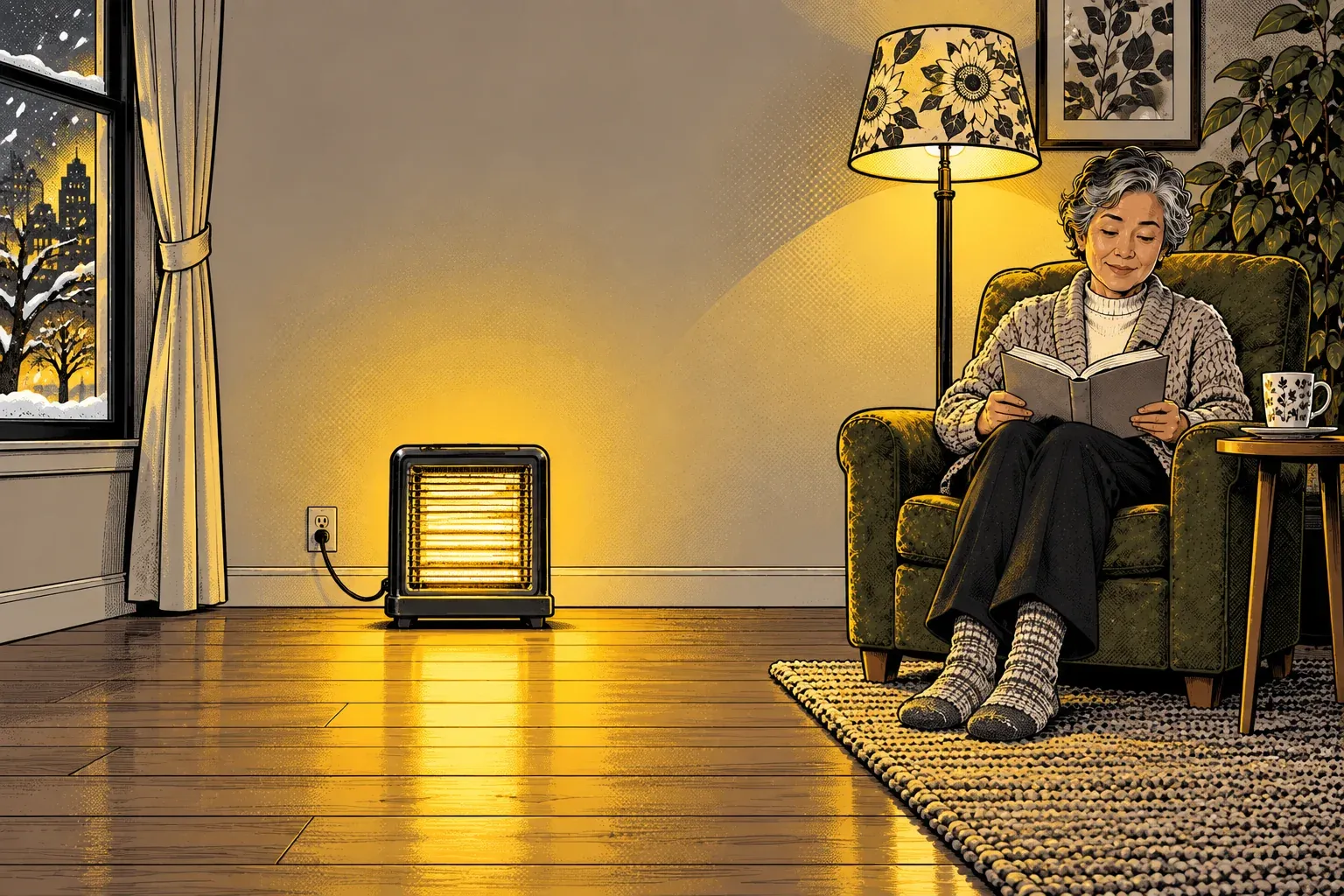
That 12.5-amp draw is also why a heater can trip a breaker when something else on the same circuit is running. If a breaker keeps tripping while the heater runs, stop resetting it and call a licensed electrician.
Two numbers from your bills
Before the first cold week, take your electric rate and multiply it twice. Times 1.5 is what an hour on high costs. Times 29.3 is the gas price per therm the heater has to beat, and if your central heat is electric baseboard, you can skip that one and start closing doors.