health · 6 min read
Does Cracking Your Knuckles Cause Arthritis?
That pop is gas in the joint fluid, and the old arthritis warning has been tested, once by a doctor using his own two hands.
By WarmLark Editors · Updated October 2026

Cracking your knuckles hasn’t been linked to arthritis in the studies that went looking for a link. A doctor ran one of those tests on his own two hands, and it took him more than 60 years.
The pop you hear is a pocket of gas opening up in the fluid inside your joint. Scientists still argue over the exact instant the sound happens, but nobody in that argument thinks your bones are grinding together.
What makes the pop?
The pop comes from the two surfaces of your knuckle joint pulling apart fast enough to open a gas-filled cavity in the fluid between them. That fluid, called synovial fluid, sits inside a sealed capsule around each of your finger joints and holds dissolved gas.
When you bend or pull a finger, you stretch the capsule and the pressure inside it drops. Your joint surfaces cling together for a moment, then let go all at once.
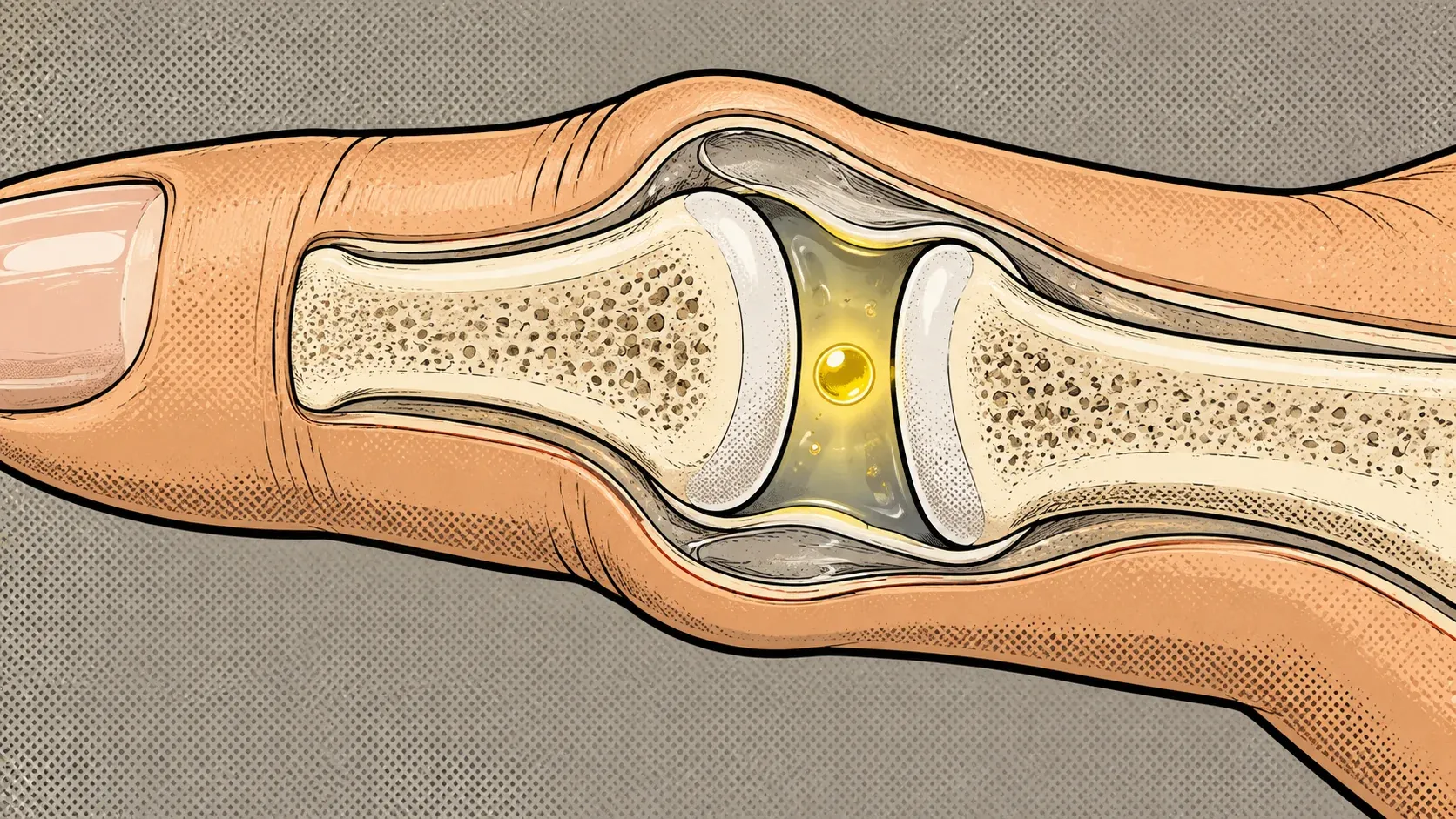
Isn’t it a bubble bursting?
That’s the explanation you’d have heard for decades. In 1971, Unsworth and two colleagues argued in the Annals of the Rheumatic Diseases that the sound came from a bubble collapsing.
In 2015, Gregory Kawchuk’s team at the University of Alberta put that idea inside an MRI scanner. They slid a finger of one volunteer, a man who could crack his knuckles on demand, into a tube attached to a cable and pulled until the joint popped. The scanner filmed 10 joints at 3.2 frames per second.
Their paper in PLOS ONE reported that the sound arrived as a dark cavity appeared, and the cavity was still there afterward.
That didn’t end the debate. In 2018, engineers at Stanford and France’s Ecole Polytechnique published a math model in Scientific Reports showing that a bubble collapsing only partway could make a sound that matches recorded knuckle cracks. A partial collapse leaves some gas behind, so the model fits the MRI too.
Will cracking them give me arthritis?
You’re not raising your odds of hand arthritis, going by the studies that compared people who crack their knuckles with people who don’t.
The first one came from Mount Carmel Mercy Hospital in Detroit. Castellanos and Axelrod checked 300 patients aged 45 and over, 74 of them habitual crackers, and published the results in 1990. Hand arthritis was no more common among the crackers.
The sharper test came in 2011, from Kevin deWeber and two colleagues in the Journal of the American Board of Family Medicine. They surveyed 215 people aged 50 to 89 who’d had an X-ray of the right hand in the past 5 years, and 20 percent of them cracked their knuckles.
Arthritis showed up in 18.1 percent of the crackers and 21.5 percent of everyone else. How many years you’d cracked, and how many times a day, made no difference either.
| Year | Who ran it, and where it ran | People checked | What turned up |
|---|---|---|---|
| 1990 | Castellanos and Axelrod, Annals of the Rheumatic Diseases | 300 patients aged 45+, 74 crackers | No more hand arthritis; more swelling and a weaker grip |
| 1998 | Unger, Arthritis and Rheumatism | 1 doctor, 2 hands | No arthritis in either hand |
| 2011 | deWeber and colleagues, Journal of the American Board of Family Medicine | 215 people aged 50 to 89 | Arthritis in 18.1% of crackers and 21.5% of non-crackers |
The 2011 study also asked which joints people cracked, and cracking a joint didn’t raise the arthritis risk in that same joint.
Does it weaken your grip?
One study found a weaker grip in crackers, but it can’t tell you the cracking caused it. In the 1990 Detroit study, the crackers had more hand swelling and a weaker grip than the people who didn’t crack.
The same crackers were also more likely to do manual labor, smoke, drink alcohol and bite their nails. With that many differences between the two groups, any one of them could explain the weaker grip.
Didn’t a doctor test this on himself?
He did. Donald Unger cracked the knuckles of his left hand every day for more than 60 years, in the words of his Ig Nobel Prize citation, and left his right hand alone as the control.
He wrote up the result in a 1998 letter to the journal Arthritis and Rheumatism. Its title asked “Does knuckle cracking lead to arthritis of the fingers?” The British charity Arthritis UK says he cracked them at least twice a day and puts the left hand’s count at a minimum of 36,500 cracks.
Neither of his hands had arthritis.

According to The Tech, MIT’s student newspaper, he used his acceptance speech to tell his mother, whose warnings he had ignored, that she was wrong. One man’s two hands can’t settle the question for you or anyone else, which is why the larger studies carry more weight. Sixty years is still a long time to keep one hand as a control.
Why can’t I crack the same knuckle twice in a row?
Your joint needs time for the gas to dissolve back into the fluid, and until it does there’s no fresh cavity to open. Researchers call that wait the refractory period.
The figure you’ll see most often is about 20 minutes. It goes back to a 1947 study in the Journal of Anatomy by Roston and Haines at St Thomas’s Hospital Medical School in London, and Kawchuk’s team cited it again in 2015. Arthritis UK gives a looser estimate of about 30 minutes.
The wait is a handy clue that the noise comes from gas, since a sound made by bone or tendon wouldn’t need to recharge.
When should a cracking joint worry me?
If the pop doesn’t hurt you, it’s the ordinary kind.
If your joint is painful, swollen, or won’t bend or straighten all the way, show it to a doctor whether it cracks or not. Arthritis UK draws the line at swelling or stiffness in your hands that you can’t explain and that lasts more than a few days, or joints that hurt when you touch them. A pop that starts right after you fall or hurt your hand is worth a visit too.
The everyday knuckle pop is gas coming out of a liquid when the pressure around it drops. You can watch the same thing happen when you twist the cap off a cold bottle of seltzer.