health · 6 min read
Why Do I Get Sleepy After Lunch Even When I Slept Well?
The early-afternoon slump is built into your body clock, even after a full night's sleep. A short nap or a bright window helps.
By WarmLark Editors · Updated October 2026
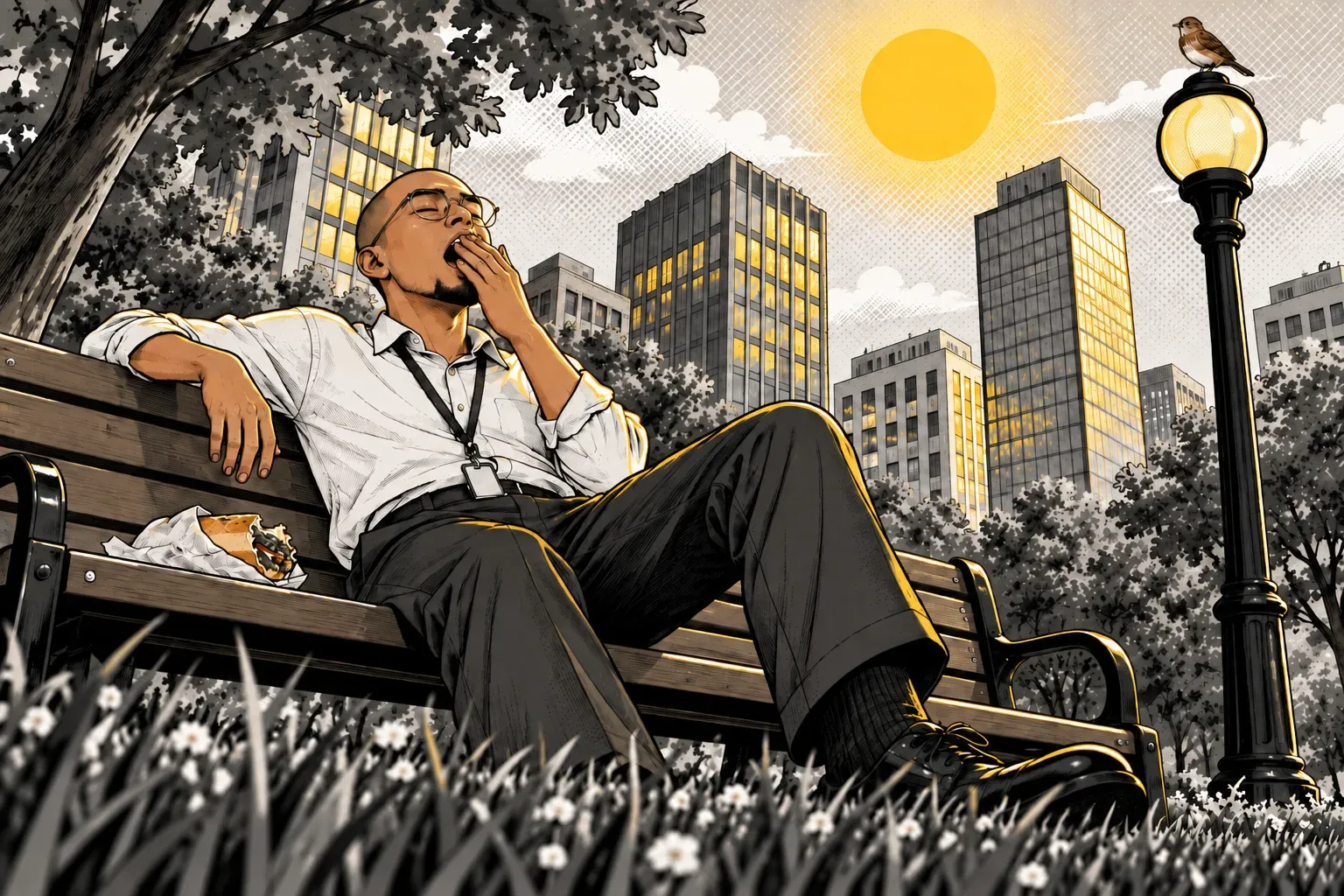
You get sleepy after lunch mostly because your body clock schedules a dip in alertness for the early afternoon, whether you slept well or not. A heavy lunch can make the slump deeper.
The best evidence comes from lab studies summed up by Timothy Monk, a sleep researcher at the University of Pittsburgh, in a 2005 review in the journal Clinics in Sports Medicine. The dip showed up even in people who had eaten no lunch and couldn’t tell what time it was.
Two forces run your energy
Sleep scientists still explain your daytime energy with a model the Swiss researcher Alexander Borbély published in 1982. Its two parts are enough to explain most of the afternoon slump.
The first part is sleep pressure. From the moment you wake up, a need for sleep builds in the brain hour by hour until sleep clears it. By early afternoon you’ve been awake for 6 or 7 hours, long enough to build up a fair amount of it.
The second part is your circadian clock, the 24-hour timer in the brain that keeps you awake through the day. Its alerting signal climbs to hold back the growing pressure, but it doesn’t climb evenly. When it sags for a while in the early afternoon, you feel more of the pressure that’s been building since breakfast.
Then the signal picks up again and stays strong into the evening, holding off a full day’s sleep pressure until bedtime gets close.
If your slump lands at about the same time most days, plan around it. Put routine tasks in that window and keep your hardest thinking for the morning.
Why a good night doesn’t cancel it
A full night’s sleep lowers the pressure you carry into the day, so the dip feels milder. It can’t remove the clock’s share of the dip, which arrives on schedule either way.
Short sleep changes the picture, since every hour you’re short adds to the pressure you bring into the afternoon. The same small dip that once meant a yawn or two can now make it hard to keep your eyes open. The CDC recommends at least 7 hours a night for adults. Its 2016 report on a survey of 444,306 adults found that 35 percent got less than that.
If you’re in that group, the early afternoon is where the shortfall tends to show.
What lunch adds to the dip
What you eat does play a part. Monk’s review lists a high-carbohydrate lunch as one of the things that make the dip worse. A plate of pasta with bread arrives right as your alerting signal starts to sag.
People blame lunch because it’s the last thing they did before the slump hit. Skip it and the dip still comes, as the studies in Monk’s review found.
The dip doesn’t need a siesta culture
The afternoon rest is traditionally built into the day in Spain, Greece and parts of Latin America, where people often credit the heat for it.
Heat may well play a part, but the dip itself doesn’t need a hot climate. You’ll find it in places where nobody stops work after lunch.
Britain makes a good test. In a 1995 paper in the BMJ, Jim Horne and Louise Reyner of the Sleep Research Laboratory at Loughborough University looked at 679 crashes on roads in southwest England and on midland motorways in which the driver had fallen asleep. Those crashes clustered around 2 a.m., 6 a.m. and 4 p.m. That afternoon peak came from a country with no siesta habit.
If a long drive is on your schedule, avoid starting it in the mid-afternoon after a short night.
A short nap, finished early
If you can lie down, a short nap is the strongest fix. At Flinders University in Australia, Amber Brooks and Leon Lack held 24 young adults to 5 hours in bed one night, then tested naps of different lengths the next afternoon. They published the results in the journal Sleep in 2006.
A 10-minute nap helped right away, with a lift that lasted up to 155 minutes. A 20-minute nap helped too, but its benefit took about 35 minutes to show up. The 5-minute nap did almost nothing. A 30-minute nap left people groggy and slower at first, and only helped later.
On a workday, the 30-minute nap is a bad trade, since you pay for it with grogginess right when you need to be sharp. Keep yours to 10 to 20 minutes, set an alarm and finish before mid-afternoon.
A long or late nap may also make it harder to fall asleep at night, since it clears some of the sleep pressure that builds toward bedtime.
Light, a walk and a lighter plate
If you can’t nap at work, bright light is the next best thing. In a 2006 study also published in Sleep, Kosuke Kaida and colleagues in Japan sat 16 women indoors beside a window, where natural light reached about 3,260 lux, for 30 minutes right after lunch. They compared that with a dim room under 100 lux.
After the bright window light, the women felt less sleepy for at least an hour.
The closest match to that study is a seat by a bright window. A short walk outside is another way to get daylight after lunch, though the study didn’t test walking.
On days when you need a sharp afternoon, try a smaller, lighter lunch. Monk’s note that a high-carbohydrate lunch deepens the dip is reason enough to test it for a week.
When sleepiness is more than a slump
Ordinary afternoon sleepiness passes. You yawn, push through or nap, then it lifts later in the day. Three patterns aren’t ordinary and are worth a call to your doctor.
Nodding off while driving is the first. In a CDC survey of 147,076 adults in 19 states and Washington, D.C., published in 2013, 4.2 percent said they had fallen asleep at the wheel at least once in the past 30 days, about 1 in 25. If your eyes start closing on the road, pull over somewhere safe and stop.
The second is a slump that’s new, or suddenly much heavier than your usual. The third is sleepiness that lasts all day, even after full nights of sleep.
Your doctor can work out what’s behind any of the three, and the driving one is the most urgent. In that same CDC survey, adults who usually slept 6 hours or less were more likely to say they had nodded off at the wheel.