health · 6 min read
Why Do We Get Goosebumps?
Goosebumps are a reflex left over from furrier ancestors, and they still fire when a song or a cold gust gets to you.
By WarmLark Editors · Updated October 2026

You get goosebumps when a tiny muscle at the base of each hair tightens and pulls the hair upright, raising a small mound of skin around it. The order comes from your sympathetic nervous system, the fight-or-flight wiring that also speeds up your heart, and it fires when you’re cold, when you’re scared and sometimes when a song hits you just right.
In a cat or a porcupine, that reflex still does real work. In you, with far less hair, it’s mostly a leftover, though a 2020 Harvard study in mice found the same wiring has a second job.
A tiny muscle at every hair
Each hair on your body grows from a follicle, a small pocket that sits at a slant in your skin. A thin strip of smooth muscle called the arrector pili, Latin for “raiser of the hair,” runs from the side of that follicle up to just under the surface.
You can’t flex this muscle on purpose.
When a nerve signal reaches it, the muscle shortens, the follicle tips upright and the hair stands up, dragging the skin around it into a little bump you can feel with a fingertip.
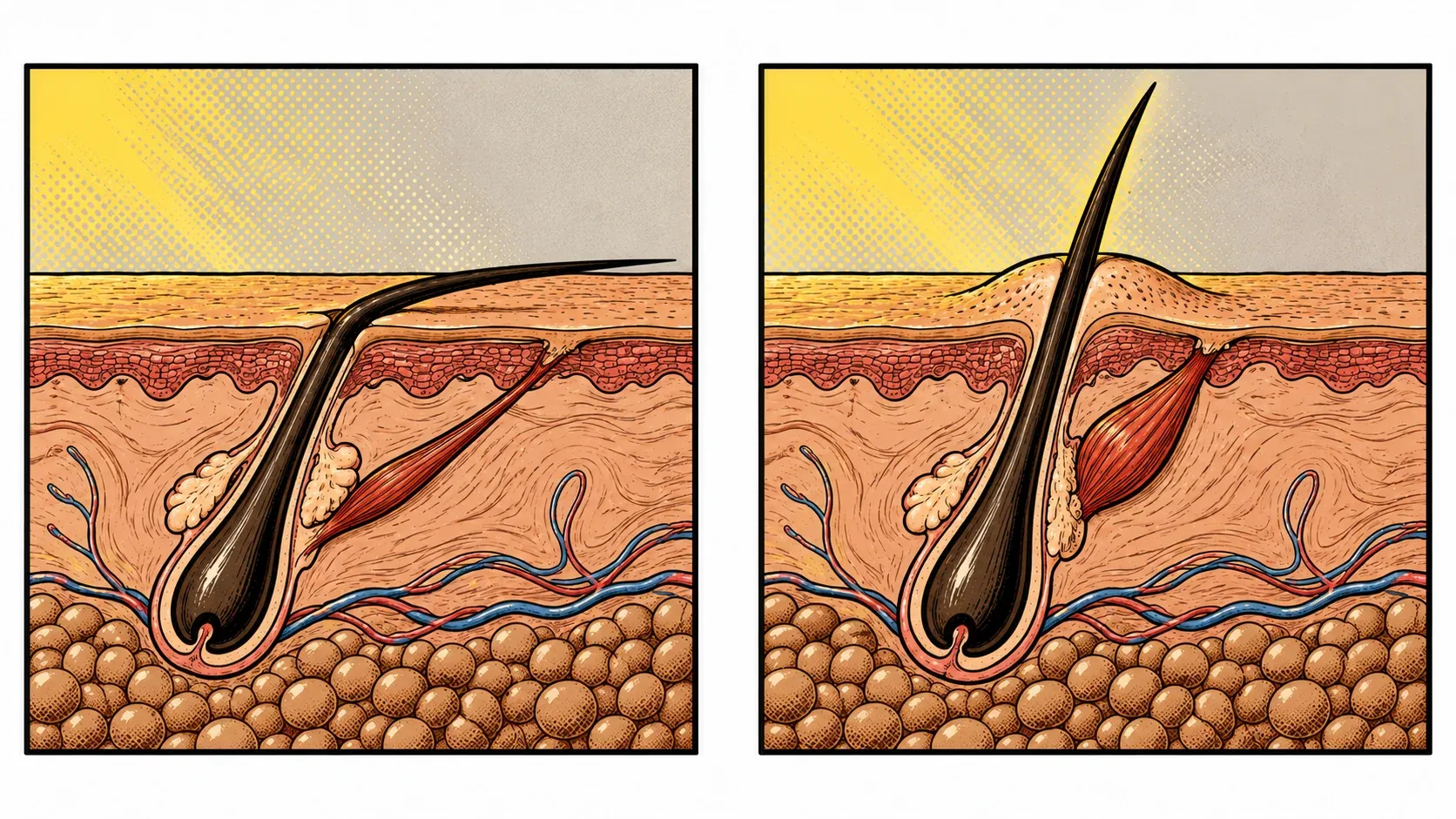
A sudden fright fires the same nerves, and a rush of adrenaline in your blood can set the muscles off too. That’s how a scare can raise bumps along both of your arms at once, with no cold air anywhere near you.
Fur that fluffs and bristles
In an animal with a real coat, the muscle has two jobs, and the first is warmth. Raised fur traps a thicker layer of still air next to the skin, and that air holds in body heat the way a puffy winter jacket keeps you warm.
The second job is bluffing. A cat facing a strange dog arches its back, the fur along its spine stands up and its tail puffs out, so it looks bigger and tougher than it is.
The porcupine takes the bluff furthest, since its quills are stiff, modified hairs that rise whenever the animal feels threatened.
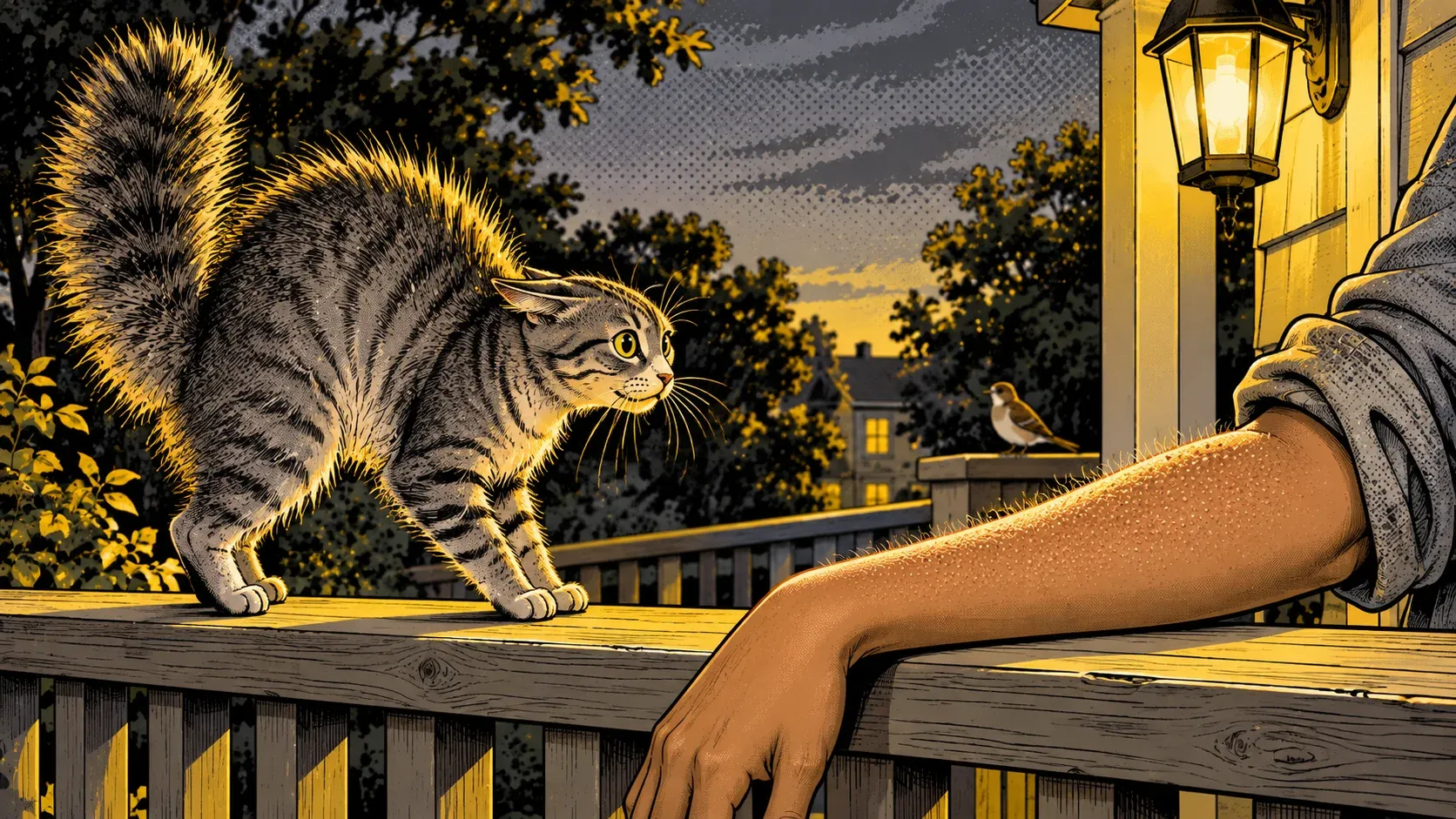
Your body still runs the full reflex, but with short, thin hair on most of your skin, there isn’t enough coat to trap much warm air or to scare anyone off, and all you’re left with is the bumps.
What Darwin saw at the zoo
Charles Darwin spent several pages on bristling in his 1872 book, The Expression of the Emotions in Man and Animals, tracing it through mammals, birds and reptiles.
Hardly any expressive movement is so general as the involuntary erection of the hairs, feathers and other dermal appendages.
Charles Darwin, 1872
A keeper at the Zoological Gardens in London told him that the chimpanzees’ hair rose when a thunderstorm frightened them. Darwin also watched an angry Anubis baboon bristle along its back from the neck down.
He saw cold do it too. His mules and dogs, after a night on the bleak Cordillera of the Andes, had their hair standing “as erect as under the greatest terror.”
That’s the same pairing of cold and fear that you can feel on your own arms.
The nerve that also grows hair
For a long time your version looked like a reflex with nothing left to do. Then in 2020, a team led by Ya-Chieh Hsu at Harvard, working with Sung-Jan Lin of National Taiwan University, published a paper in the journal Cell that found new work for the goosebump wiring, with Yulia Shwartz as first author.
Working in mice, the team found that the nerve doesn’t stop at the muscle. It also reaches the stem cells that build new hair, and it signals them with norepinephrine, a chemical messenger. The arrector pili muscle holds that nerve in place, and in mice whose muscles never formed, the nerve’s link to the stem cells was lost as well.
Cold put the whole circuit to work in the mice. Right away, the nerve tightened the muscle and raised goosebumps, and over a longer cold spell it fired harder until the stem cells woke up and started growing new hair.
The work was done in mice, so it can’t tell you whether a cold winter does anything to your own hair.
Why a song can set it off
Your goosebumps can also fire with no cold and no threat at all. A swell in a song, a key change or a choir coming in can send a shiver down your back and raise the hair on your arms. Researchers call it a musical chill, or frisson.
Darwin noticed this as well, describing “the thrill or slight shiver which runs down the backbone and limbs of many persons when they are powerfully affected by music.”
Measuring it took about another century.
In 1980, the Stanford pharmacologist Avram Goldstein surveyed people about their “thrills” and found that music was the most dependable trigger. He then gave a few listeners naloxone, a drug that blocks the body’s own opioids, and their thrills faded in some of them.
What the brain scans showed
In 2001, Anne Blood and Robert Zatorre at McGill University had 10 trained musicians, five women and five men, each pick a classical piece that reliably gave them chills. They scanned the musicians’ brains with PET while the music played.
As the chills grew stronger, blood flow shifted in the ventral striatum and other areas that also respond to food and sex. When a favorite song gives you chills, it’s tapping the same reward areas as a good meal.
| Year | Study and journal | What it found |
|---|---|---|
| 1980 | Goldstein, Physiological Psychology | About half of those surveyed got thrills, most often from music |
| 2001 | Blood and Zatorre, PNAS | Chills track with activity in the brain’s reward areas |
| 2016 | Sachs and colleagues, Social Cognitive and Affective Neuroscience | People who get chills have more fibers linking hearing areas to emotion areas |
If music never gives you chills
Goldstein’s survey had already hinted at the answer, since only about half of the people he asked reported thrills at all.
In 2016, Matthew Sachs, Psyche Loui and colleagues screened more than 230 people with an online survey. They then brought 10 who often got chills and 10 who never did into the lab, each with their own favorite music. Brain scans showed the chill group had more fibers linking the hearing areas of the brain to the insula and other regions that handle emotion. The no-chill group had the same pathways, only smaller in volume.
Nothing was missing in the people without chills. If you’ve never had one, nothing in this research says you enjoy music any less, and plenty of people who love music never get a single bump from it.
Palm skin has no hair follicles and no arrector pili muscles, so it can’t form goosebumps at all. When a cold draft or a song raises the bumps on your arms tonight, turn your hands over, and you’ll find the skin on your own palms still smooth.