household · 7 min read
Why Does My House Creak at Night?
Most nighttime creaks and pops come from wood, ducts and pipes shrinking as the air cools, and a few sounds deserve a pro.
By WarmLark Editors · Updated October 2026
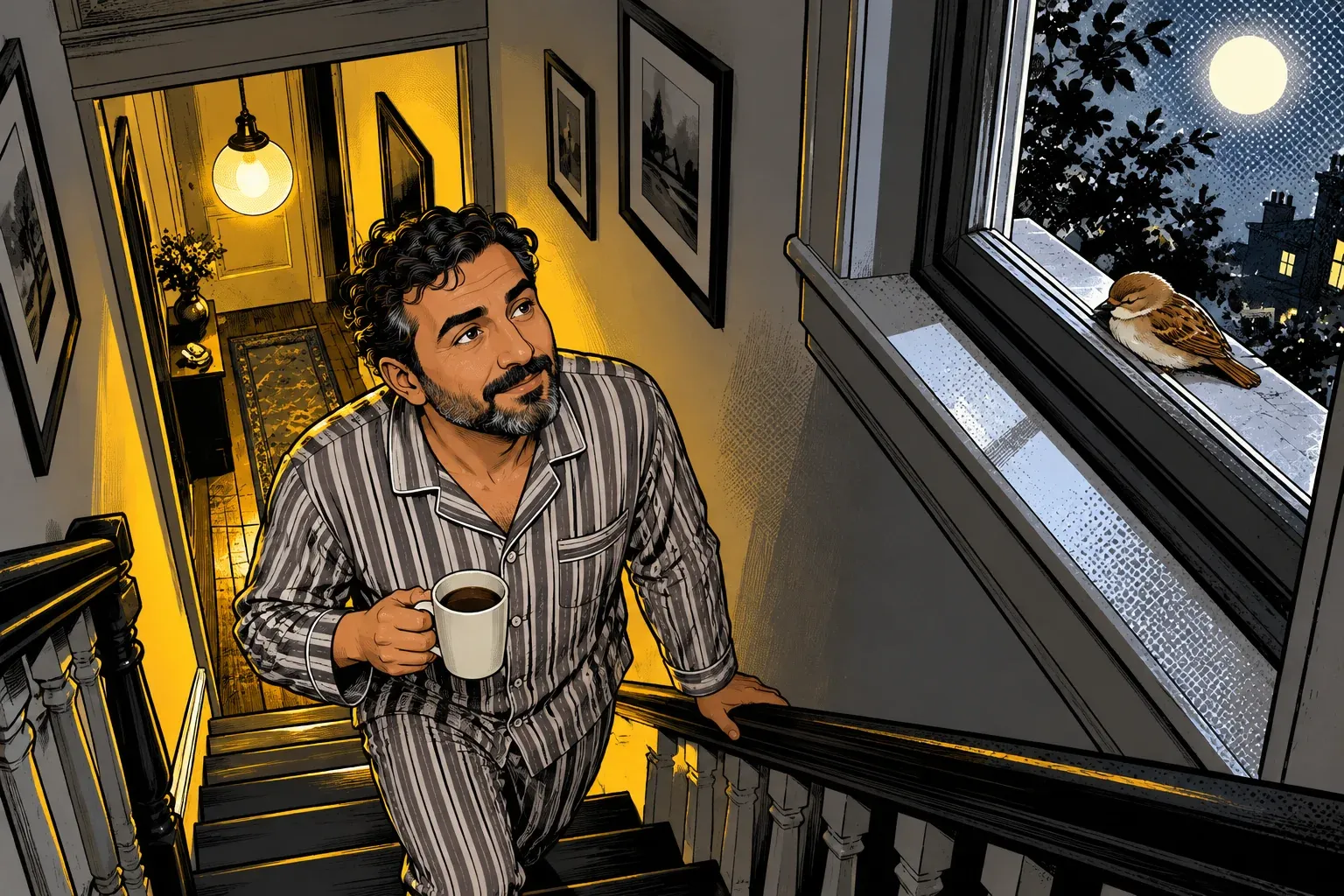
Most of the creaks and pops you hear at night come from your house cooling down after sunset. Wood framing, sheet-metal ducts and water pipes all shrink as they cool, at different rates and different speeds. Where two of them meet, one slips against the other and you hear a tick, a snap or a long, slow creak.
You also notice it more once the house goes quiet. With the dishwasher done and the street empty, the same small noises your house makes all afternoon finally reach you.
Almost all of these noises are harmless, though a handful of warning signs mean you should call a professional instead of waiting for the sound to stop.
Wood moves across the grain
The Wood Handbook, the U.S. Forest Products Laboratory’s standard reference on lumber, opens its chapter on moisture by calling wood hygroscopic. It trades water with the air around it. Once wood dries below about 30 percent moisture content, a point the handbook calls fiber saturation, it shrinks as it loses water and swells as it takes water back.
That movement is lopsided. Wood shrinks most along its growth rings, about half as much across them, and only 0.1 to 0.2 percent along its length.
A joist under your floor stays almost the same length for decades, but its depth and your floorboards swell and shrink with the weather.
The handbook’s Table 4-3 gives the numbers for green, freshly cut wood dried all the way out. Coast Douglas-fir shrinks 7.6 percent along the rings and 4.8 percent across them. Loblolly pine comes in at 7.4 and 4.8, western hemlock at 7.8 and 4.2, and Engelmann spruce at 7.1 and 3.8.
What dry air does to a floor
Indoor wood never gets soaking wet or bone dry. How much it shrinks depends on how dry you keep the air inside. The handbook’s Table 4-2 shows that at 70°F, wood in air at 50 percent relative humidity settles at 9.2 percent moisture content. Drop the air to 30 percent and the same wood heads for 6.2 percent.
Run that 3-point drop through the handbook’s shrinkage formula and a 5½-inch-wide Douglas-fir board gives up about 0.76 percent of its width, a little over 0.04 inch, or about a millimeter. Every joist, stair tread and subfloor panel in your house does the same thing, and the handbook lists gaps in flooring among the usual results.
A board that rubs its neighbor or slides along a nail shank creaks when you step on it.
Winter dries the house out
Day-to-day humidity swings matter less than you might expect. The handbook notes that short-term changes in humidity tend to reach only the surface of the wood. The seasons do most of the shrinking, with winter heating drying your air most of all. The nightly drop in temperature is what sets the loosened parts ticking.
The EPA’s guide to mold and moisture says to keep indoor humidity below 60 percent, ideally between 30 and 50 percent. At room temperature that range holds wood at roughly 6 to 9 percent moisture.
A basic hygrometer from a hardware store shows you where your house sits.
Where the noises start
Each part of your house has a sound of its own, and where you hear it tells you a lot about the cause.
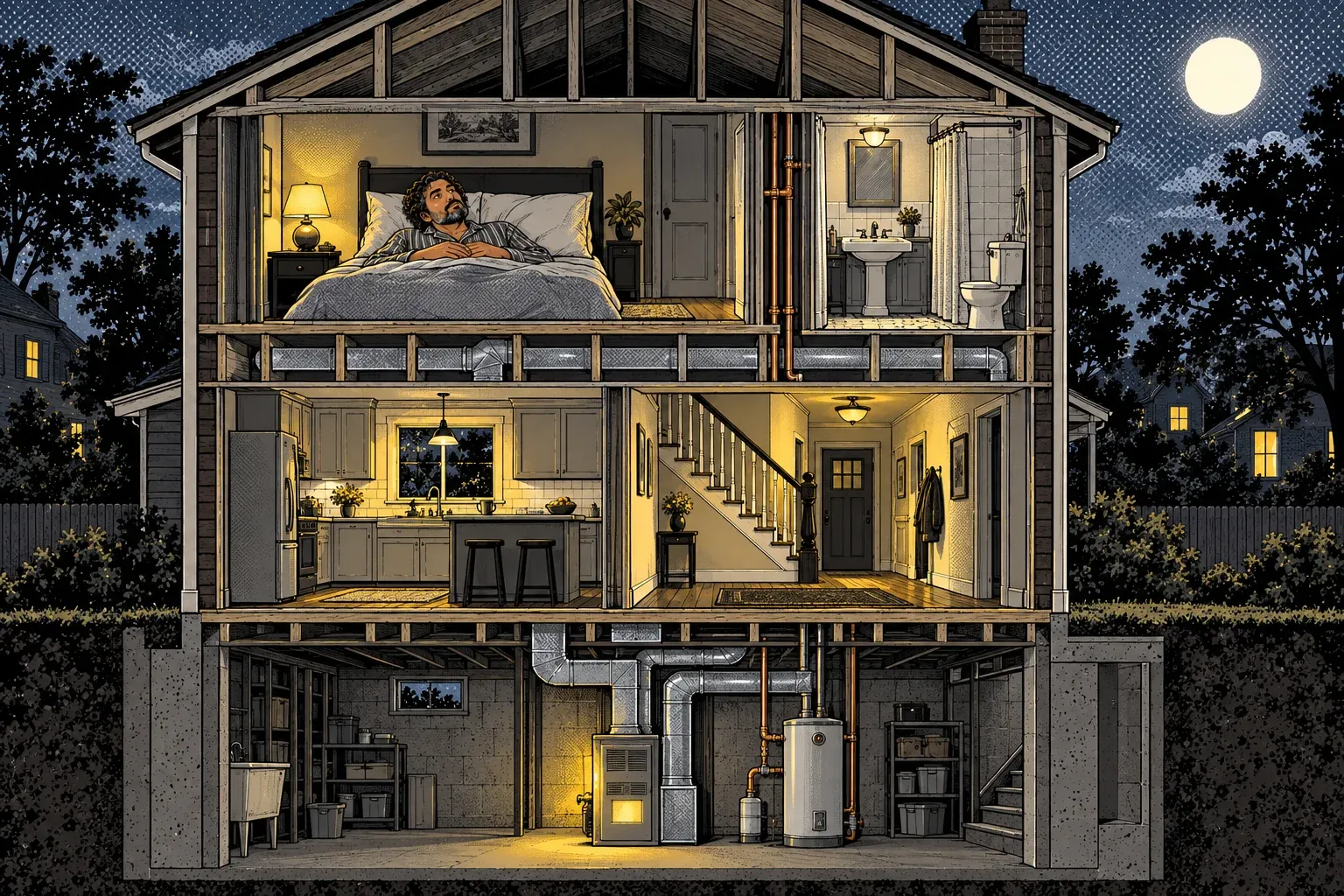
Working from the top of the house down, the usual sources are:
- The roof, which ticks and creaks as its outer layer cools.
- The ducts, which pop when the heat comes on and tick as they cool after it shuts off.
- The water pipes, which tick while hot water runs and can bang when a valve snaps shut.
- Floors and stairs, which creak under feet and sometimes on their own as the air dries.
The roof cools first
On a clear night your roof loses heat straight to the sky. That’s radiative cooling, the same effect that puts frost on your windshield on nights when the air never drops below freezing. The roof boards and shingles cool faster than the rafters and attic air underneath them, so the outer layer shrinks while the frame holding it lags behind.
Nails slip a hair and the boards rub the rafters. You hear it as a run of ticks from the ceiling in the first few hours after dark.
Clouds blunt the effect by sending some of that heat back down, which is one reason some nights sound louder than others.
Ducts and pipes grow with heat
Metal ducts react to temperature within minutes. ASM International’s ready reference on the thermal properties of metals lists plain carbon steel at 6.5 millionths of an inch per inch for every degree Fahrenheit. Take a 20-foot run of steel duct that warms 50 degrees when the furnace starts. It grows about 0.08 inch, or 2 millimeters.
Straps and screws hold that duct in place, so the flat sheet metal can’t slide. It bows out with a pop and snaps back as it cools after the burner shuts off.
If your thermostat turns the heat down overnight and back up before you wake, the first heat cycle of the morning can be the loudest pop you hear all day.
Copper moves even more. The sheet metal contractors’ trade group, SMACNA, lists copper at 9.4 millionths per degree in its architectural sheet metal manual. A 30-foot copper hot-water line that warms 60 degrees during a late shower grows about 0.2 inch. Where the pipe passes through a tight hole in a joist or rests on a strap, it drags and ticks, then ticks again as it cools.
The bang when water stops
A single hard bang, or a burst of banging, right after water shuts off has a different cause. Water moving through a pipe has momentum. When a dishwasher, washing machine or toilet fill valve closes fast, the water stops short and the pressure spikes. That shock bounces back and forth through the plumbing and knocks the pipes against the framing.
Plumbers call it water hammer, and you’ll hear it at night if your dishwasher runs on a delay or someone flushes at 2 a.m.
A licensed plumber can fit a water hammer arrestor, a small shock absorber that sits between the pipe and the appliance. The same visit can check whether your water pressure runs high.
Signs that need a professional
Sounds that follow the temperature and then fade are normal. The signs below don’t fade, and most get worse while you wait. None of them is a do-it-yourself job.
| Sound or sign | Likely cause | Who to call |
|---|---|---|
| Rotten-egg smell or a hiss near a gas line | Gas leak | Leave first, then the gas utility or 911 from outside |
| New cracks in walls or ceilings that keep widening | Foundation or framing movement | A structural engineer |
| Doors or windows that suddenly stick | Framing pulled out of square | A structural engineer |
| A floor that sags or turns springy | Damaged joist, rot or a leak below | A structural engineer or licensed contractor |
| Banging every time water shuts off | Water hammer | A licensed plumber |
| Booming, squealing or rattling from the furnace | Burner or blower trouble | A licensed HVAC technician |
| Crackling or buzzing at an outlet or the breaker panel | Loose or overheating wiring | A licensed electrician |
A door that sticks every humid summer and frees up in winter is ordinary swelling, and it isn’t on this list.
Gas comes first, every time. Utilities add mercaptan to natural gas so a leak smells like rotten eggs.
If you smell it, get everyone out of the house without flipping light switches or using anything that could spark. Call your gas utility’s emergency line or 911 once you’re outside and well away from the building.
For the next week, jot down when each sound happens and what was running at the time, whether that’s the furnace, the dishwasher or a late shower, since the timing usually points to the cause. Walk the house once in daylight and look for the signs in the table. If you find one, call the pro on that row before you go hunting for the noise.
If everything checks out, the creaks are ordinary cooling and drying. On a cold morning when the stairs creak more than usual, the cause often shows up as a reading under 30 percent on the hygrometer in your living room.