relationships · 7 min read
Is There Really a Vein From Your Ring Finger to Your Heart?
The ring finger custom rests on a Roman belief in a 'vein of love' that anatomy disproved, and many countries use the right hand.
By WarmLark Editors · Updated October 2026

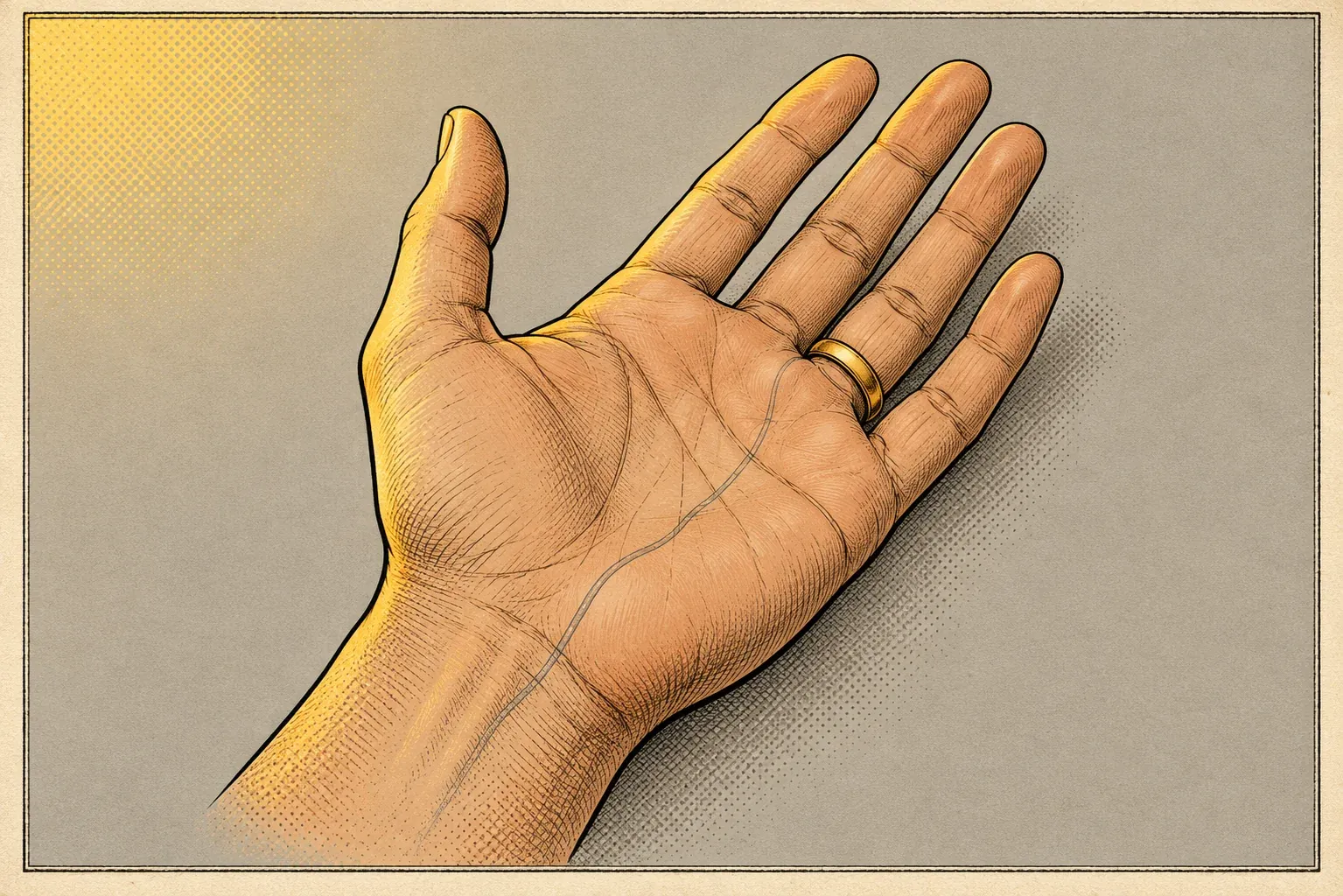
Every finger on your hand carries blood back to your heart through its veins, and the ring finger’s veins take the same route as all the others. The “vein of love,” or vena amoris in Latin, was an old belief that one vessel ran straight from the fourth finger of the left hand to the heart. It probably decided which finger your own ring sits on, but it was never anatomy.
Churches and families decide which hand gets the ring, and much of the world uses the right.
Where the vein-of-love idea came from
One of the oldest written explanations sits in Attic Nights, a book of notes by the Roman writer Aulus Gellius from the 2nd century. “I have heard that the ancient Greeks wore a ring on the finger of the left hand which is next to the little finger,” he wrote, in John Rolfe’s 1927 translation.
You might expect a Roman reason, but Gellius took it from Apion, a scholar from Egypt, whose Egyptian History claimed that dissections there had found “a very fine nerve” running from that finger alone to the human heart.
If you read that closely, you’ll see he wrote nerve, not vein. Macrobius repeated the nerve version in his Saturnalia in the 5th century, and by around 630, Isidore of Seville, a bishop in Spain, was describing a vein that linked the finger to the heart.
The whole passage is chapter 10 of Book 10 of Attic Nights, and it runs only a few lines.
The prayer book that fixed the finger
The left hand wasn’t always the English custom. The 1910 Catholic Encyclopedia notes that the medieval Sarum rite, the Latin service used across much of England before the Reformation, placed the ring on the bride’s right hand. English Catholics kept that habit until the middle of the 1700s.
The first Book of Common Prayer, issued under Archbishop Thomas Cranmer in 1549, settled the question for the Church of England. Its marriage service has the man lay “a ring, and other tokens of spousage, as gold or silver” on the book. The next rubric, in modern spelling, names the finger:
And the priest taking the ring shall deliver it unto the man: to put it upon the fourth finger of the woman’s left hand.
The groom then said, “With this ring I thee wed: This gold and silver I thee give.”
Later editions kept the left hand, and weddings across the English-speaking world followed the book. The rubric itself gives you no reason. Anthony Sparrow, later a bishop, supplied one in his 1657 Rationale upon the Book of Common Prayer, writing that the ring goes on that finger “because there is a vein that goes from thence to the heart.”
What anatomy says about the vein
William Harvey’s 1628 book on the motion of the heart and blood showed that blood travels in a loop. It leaves the heart through the arteries and comes back through the veins, which means every vein in your hand ends up at your heart sooner or later.
Each of your fingers drains into the same web of veins on the back of the hand. That web feeds the larger veins that run up your forearm, and nothing in it gives the fourth finger of the left hand a private line. Turn your hand palm down in good light and you can see part of that web for yourself, with veins from every finger, the thumb included, heading for the wrist.
Sparrow also said what the vein stood for, and that part holds up far better than his anatomy. In his reading, a ring on that finger signified “that the love should be hearty,” a meaning you can keep even after the anatomy is gone.
Which hand, country by country
Travel through central and eastern Europe and you’ll see rings on right hands everywhere, and Orthodox churches build that hand into the service. The Greek Orthodox Cathedral of the Annunciation in Atlanta tells couples that the priest places the rings “on the ring fingers of the right hands of both the bride and groom,” since the right hand was the hand of authority.
| Country | Usual hand | Source |
|---|---|---|
| United States, Canada | Left | Aleteia, a Catholic news site, 2022 |
| United Kingdom | Left | The 1549 Book of Common Prayer |
| Switzerland | Left | Wissenschaft.de, a German science site, 2023 |
| Germany, Austria | Mostly right | Wissenschaft.de, 2023 |
| Poland | Right | Aleteia, 2022 |
| Spain, Colombia | Right | Aleteia, 2022 |
| Russia, Greece | Right | The Orthodox betrothal service |
| India | Either; no ring required | Hindu Marriage Act, 1955 |
The table shows the usual habit, not a law, so you can pick either hand.
Poland, India and the church
In Poland, a ring on the right hand became a sign of mourning in 1861. The country’s state education platform, ZPE, says that five demonstrators were killed in Warsaw that year and women went into mourning dress. As a sign of that mourning, they put their wedding rings on the ring finger of the right hand instead of the left.
India has no single rule. Under section 7 of the Hindu Marriage Act of 1955, a wedding that includes saptapadi, the seven steps the couple take together before the sacred fire, becomes binding when they take the seventh step. A ring isn’t part of that, so couples who exchange one follow their own family’s custom.
The Catholic Church doesn’t pick a hand either. “It’s not the hand that bears the ring that is symbolic, but the ring itself,” Father Pierre-Marie Castaignos told Aleteia.
If your two families come from different traditions, ask your officiant before the rehearsal which hand the service uses, so you aren’t both guessing at the altar.
When men started wearing rings
Before the 1940s, most American grooms never wore a wedding ring. Historian Vicki Howard traces the change in Brides, Inc., her 2006 history of the American wedding business. At the end of the Depression, 15 percent of couples used two rings, and by the late 1940s, about 80 percent did.
The war did much of the work, since men shipping out wore a band as a link to a wife back home.
Howard’s wider point is that jewelers had tried to sell men rings before and failed. In 1926, jewelry makers and retailers pushed engagement rings for men with radio ads, newspaper ads and window displays, and the campaign flopped. The wedding band caught on in the 1940s because it already meant something to the men wearing it.
If you have a wedding photo of grandparents or great-grandparents who married in the 1930s, look at the groom’s left hand. The odds are good that you won’t find a ring on it.
When a ring needs a doctor
The one real link between your ring finger and your health is the blood that has to get past the ring. A finger that swells after an injury, or from arthritis, can trap a band that slid on easily for years.
The American Society for Surgery of the Hand suggests three things you can try. Put soap or oil on the finger and ring, raise your hand over your head for up to 10 minutes with ice around the ring and finger, or wrap dental floss or thread around the finger to compress the swelling.
If the swelling comes from an injury or the skin is cut, see a doctor before you try anything, and see one if those steps fail. Go to an emergency room if your finger past the ring turns discolored or loses feeling.